I decided early on in my PhD-trajectory that I wanted to go on a research trip to Cuba. The research I am able to do from the Netherlands mostly consists of reading primary sources written by white elite men about the enslaved or formerly enslaved people that I am actually studying. The Cuban National Archive, meanwhile, has sources that are much closer to enslaved or formerly enslaved people, including some that were directly produced by the people themselves.
I arrived in Cuba a little over a month ago, at the beginning of February. This means I arrived here right in the middle of the ongoing crisis caused by the United States’ takeover of Venezuela, which resulted in an abrupt stop to oil exports from Venezuela to Cuba.
Because I hadn’t been to Cuba before this crisis, it is sometimes hard for me to tell which parts of the life that I am experiencing here are caused by this current crisis and which parts were this way before. For example, I had not realized the impact of the crisis on taxis – after all, I was always able to get a taxi when I wanted – until my friend and colleague, who is from Cuba and is also currently here on a research trip, told me that they are much more expensive now than they used to be.
One of the ways the power crisis is most visibly present to me, is that it has severely impacted trash collection. This means large heaps of garbage sit at many street corners. When I was first getting my bearings in my neighbourhood, I oriented myself in part with the large collection of garbage at the corner near the house I’m staying at. Occasionally, people set fire to these garbage heaps, in an attempt to reduce them.
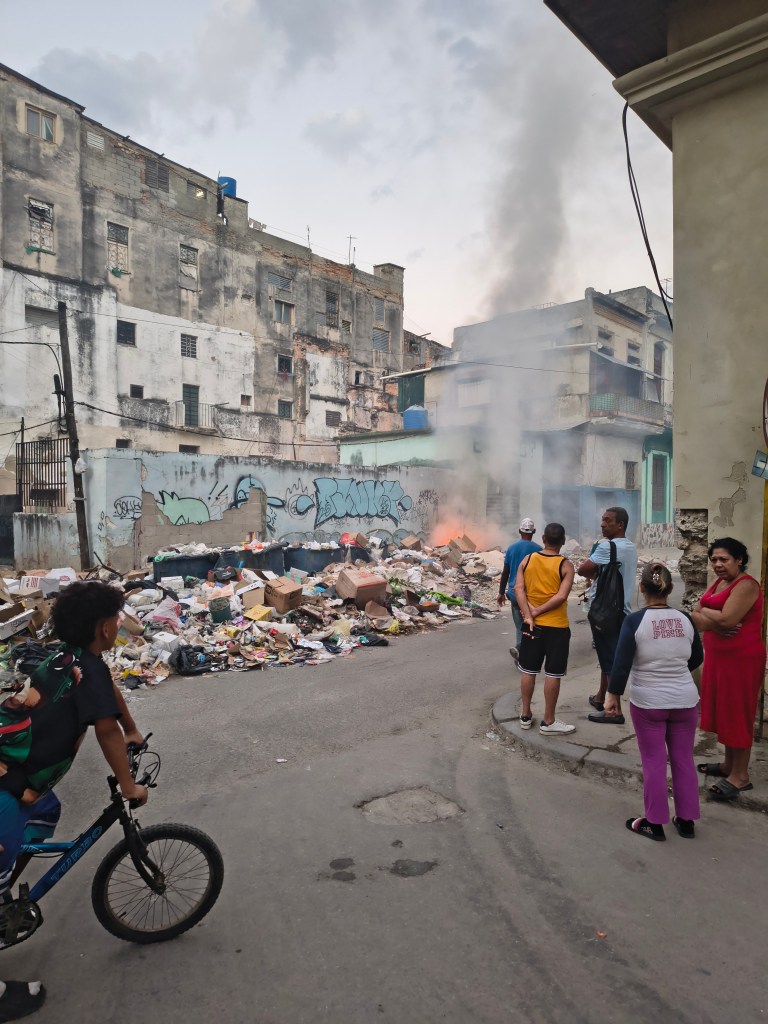
The privilege that being a Dutch visitor to Havana affords me means I have been far less affected by the crisis than the local population. If groceries or taxis get more expensive, I can still afford them. When I can’t cook because the power is out, I have the option of eating out. The way this crisis impacts me is not at all comparable to the way it hurts the Cuban population.
Furthermore, the power cuts are impacting me far less than most people in Havana, because I am staying in a part of Havana that is not affected by the power cuts that most people here in Havana experience for several hours per day. I don’t fully understand why this is the case for this part of the city, but I have been told that the reason is that the power lines here are so old that if the power is turned off, they might not be able to turn it back on. So, unlike other parts of the city, they do not temporarily turn off the power here. As a result, the total amount of time I have been without electricity in the first month I was here, was less than what people in other parts of Havana experience in a single day.
Having said that, I wrote most of this blogpost during a 24-hour power outage. Yesterday at noon, about half an hour before the archive closed for the day, the lights flickered and then went out. When I arrived home an hour later, the power was out there too. The travel agency my university works with keeps me updated about changes to the situation in Cuba that may be relevant to my stay here, and I got an email from them soon after I got home. They informed me that a large part of the country was without electricity. A couple of hours later, the water shut off too.
The power was still out when I woke up this morning. I expected that the archive would close today because of the power outage, but had no way to verify this, so I made my way there and confirmed this was indeed the case. I got another email from the travel agency around 9 AM to let me know that power was being restored to much of Cuba and that parts of Havana were already regaining power. Around noon, 24 hours after the lights had flickered out at the archive, my air-conditioning unit announced the end of the power outage with a cheerful beep.
The closing of the archive today reflects the largest impact that the power crisis has had on me personally. Since my second week here, the archive closes two hours earlier every day than it did previously in order to preserve power. Unfortunately, this will likely mean that I won’t be able to do all the work I had planned to do while here.
The final impact that this crisis will have on me will be during my trip back home. Airplanes are no longer able to get kerosine here in Cuba. This, in combination with the dramatic decrease in tourists visiting the island, has motivated airlines to cancel flights. Our travel agency emailed me yesterday to let me know that Air France is cancelling my flight home, so I will be spending some time in the coming week trying to find a replacement.
Still, I know that I will be able to get home (somehow) when my time here is done. In the meantime, aside from experiencing the effects of the power crisis, I also get to experience the lovely differences between Cuban culture and the Dutch culture that I’m used to. The streets here are so much more alive: people are eager to make conversation and get to know you, and you often see people dancing or playing dominoes. Every day, I see both this liveliness of the Cuban streets and the struggle caused by the situation here. This juxtaposition will stay with me when I find my way home.
 Racialized Motherhood
Leave a comment