By Ida L. Vos.
Last week, I returned from my two-month visit to Havana, where I did research at Cuba’s National Archive. The collection that I used at the archive is called “Miscelanea de Expedientes”, which translates to “miscellaneous files”. As the title suggests, this is an incredibly diverse collection. It contains a plethora of topics. Most documents in the collection are from the nineteenth century, a lot of the others are from the eighteenth century, and some are from the sixteenth, seventeenth or early twentieth century. These documents are about all kinds of things: ships arriving or leaving Cuba, people owing money, prisoners, soldiers, and many more topics. The collection also contains files about slavery, which is the topic I am interested in.
Unfortunately, there is no structured order to the collection. A document about a boat entering Havana might be right next to one about an enslaved woman seeking her freedom.
There is some clustering of themes. I was more likely to find documents related to slavery next to other documents related to slavery, though there is a good chance that there will be some documents about some other topic interspersed between them. Fortunately, there are a series of books, which were created in between 1922 and the 1940s, which contain the title of every document in the collection.1 This allowed me to find sources I wanted to read. The titles contained in this book were taken from the title pages of the sources themselves, which I believe were created around the time the sources themselves were created.
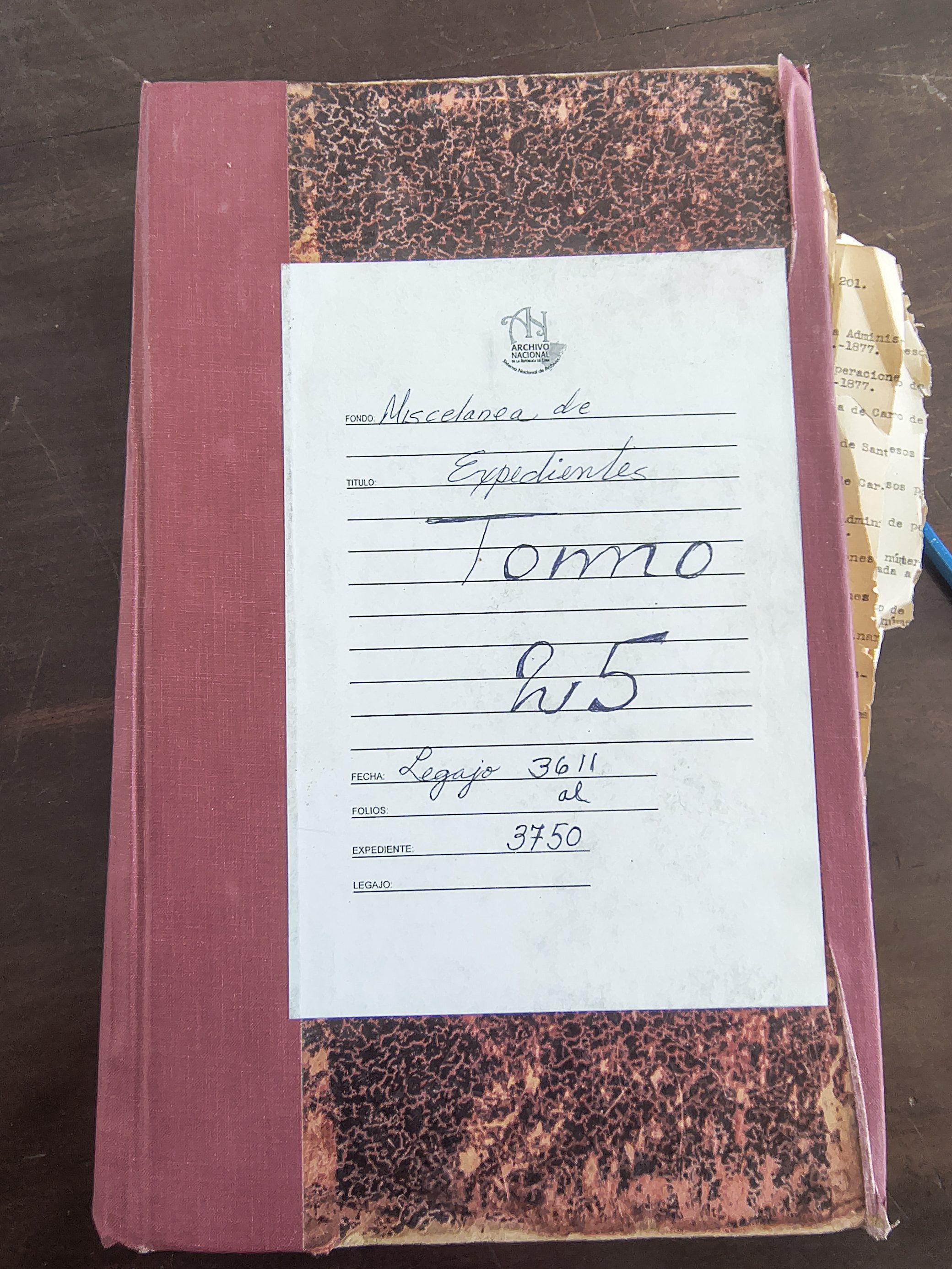
I spent a large part of my archive time going through these books, looking for documents I wanted to take a closer look at. Because I was only interested in a eleven-year period of history and almost all document descriptions include the year, I could go through the lists quite quickly.
So, I spent my time skimming the list of documents, dismissing most as irrelevant for my research. Nevertheless, while I glanced past these documents, I still got an interesting glimpse at the historical realities of eighteenth and nineteenth century Cuba.
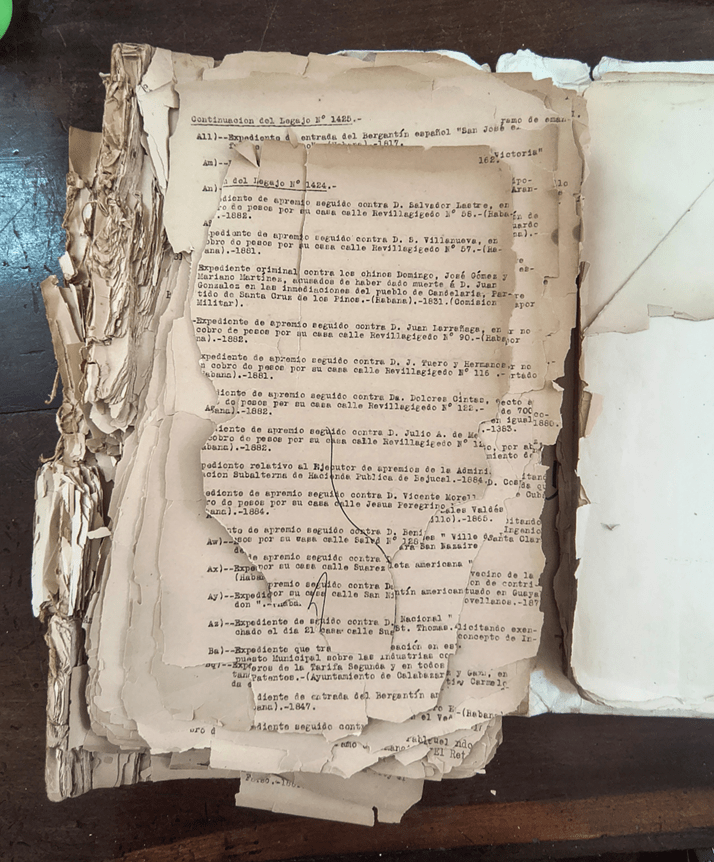
One of the aspects that most drew my attention was the systemic racialization of people of colour in these documents. When Black people were mentioned in these sources, alongside their names there is usually a descriptor of their race: “morena”, “negra”, “parda”, or “mulatta”. Justa Sanchez, who in 1871 took legal steps to try to obtain freedom for her sixteen-year old daughter, is described in this book as “la parda libre Justa Sanchez”, or “the free [female] black Justa Sanchez”.2 Like this, the creators of these sources specified with significant detail the heritage of these people. By “pardo” or “mulatto” they meant people of biracial descent. “Moreno” meant a person born in Cuba, whose ancestors were African. “Negro” suggested that the person was themselves born in Africa.3 For instance, one document was titled: “Expediente promovido por la parda libre Concepcion Moreno pidiendo la libertad de su madre la negra Sebastiana por sexegenaria”, or “File promoted by the free parda Concepcion Moreno, requesting the freedom of her mother, the negra Sebastiana, because she is a sexagenarian.”4 The first woman mentioned here, was parda, or biracial. Her mother was negra, meaning she was of fully African descent and presumably born in Africa. Although Concepcion Moreno’s father is absent from this source, we can infer from the descriptors used for both her and her mother that he was white or biracial. Like the one about Justa Sanchez, this is a document related to slavery: Concepcion Moreno was free, and her mother Sebastiana was enslaved. Because of Sebastiana’s age, she was in theory able to attain her freedom under the 1870 Moret law, that stated that enslaved people over the age of sixty would be freed.
But files with no relation to slavery also contain these signifiers of race. Next to a file titled “Documento sobre demencia de Doña Inés Muñoz” (“Document about the dementia of Doña Inés Muñoz”) we find a file called “Documento sobre demencia de la morena Inés Mandinga.” (“Document about the dementia of the morena Inés Mandinga”)5 Here, we see two women, both suffering from the same illness, incidentally also both named Inés, but the white woman gets the respectful “Doña” title, which was exclusively used for white people, while the Black woman is defined by her race.6
![Shows a page with documents that are almost all titled "Documento sobre demencia de [name]. Some of these names have "D" or "Doña"](https://racializedmotherhood.blog/wp-content/uploads/2026/04/img_20260223_113416494.jpg?w=768)
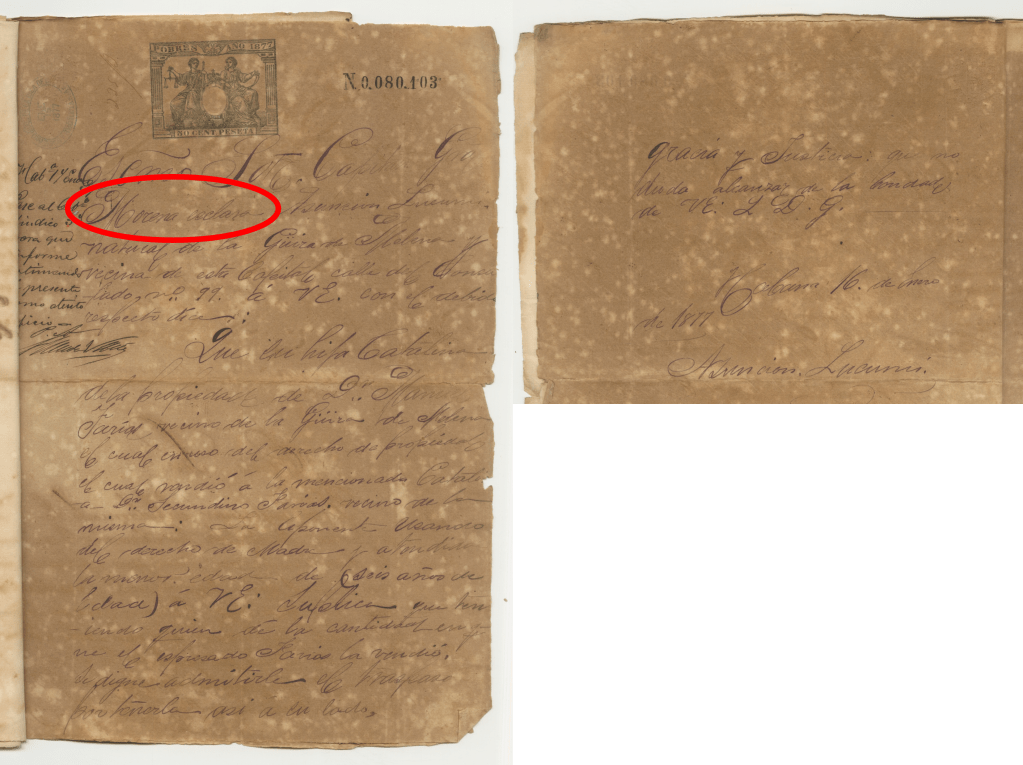
Not all white people in these sources are described with “Don” or “Doña”. For example, next to the two aforementioned files about dementia, we see “Documente sobre demencia de José María Sanz y Perez” (“Document about the dementia of José María Sanz y Perez”).7 At first, I assumed that anytime no race was mentioned, this meant the person described was perceived as white by the creators of the source. However, I have also found sources where no race descriptors are mentioned in the title, and yet I know for sure the people discussed were people of colour. For instance, in 1877, an enslaved woman named Asuncion Lucumi filed a complaint that she had been sold separately from her daughter Catalina, who was younger than fourteen. This was not allowed, and Asuncion Lucumi successfully argued that she should be reunited with her daughter. The file about this case is titled “Expediente promovido por Asunción Lucumí, en queja de que se le ha vendido a su hija menor separada de ella, propiedad de D. Manuel Farias” or “File promoted by Asunción Lucumí, about the sale of her minor daughter separately from her, property of D. Manuel Farias”, so without any race descriptors for either Asuncion Lucumi or her daughter. In the files themselves, however, these are present: Asuncion Lucumi is described as “morena”. This does not extend only to the white authorities: in Asuncion Lucumi’s original petition that started the legal proceedings, which she signed herself, she described herself as “morena esclava Asuncion Lucumi”, or “black slave Asuncion Lucumi”.8
None of this is necessarily surprising. I was well aware before I came to Cuba that Cuba in the 1870s was a deeply racist society, in which this sort of structured approach to race is to be expected. All the same, it is powerful to go over hundreds of pages in which the racialization of people is so structurally visible.
I would have been able to find the sources relevant for my research much more quickly if these books with the titles of the documents in Miscelanea were digitized. And I do love good digitalization of primary sources, because it makes research so much more efficient, and it allows us to ask different research questions. Still, there was something nice about this slower method of finding my primary sources. By reading titles of hundreds of primary sources every day, I did get a much more diverse and varied look at the history of Cuba than I would have if I had been able to use search methods that are digital and more focussed.
- Jorge L. Giovannetti and Camillia Cowling, ‘Hard Work with the Mare Magnum of the Past: Nineteenth-Century Cuban History and the Miscelánea de Expedientes Collection’, Cuban Studies 39, no. 1 (2008): 60–84. ↩︎
- Archivo Nacional de la Republica de Cuba (ANC), Miscelanea de Expedientes (ME), legajo 3745 Ai, as found in Tomo 25. ↩︎
- Ulrike Schmieder, ‘Masculine and Feminine Identities of Slaves, Patrocinados and Freedmen in Cuba in the 1880s’, EnterText 2018, no. 12 (2018), 15, https://www.fis.uni-hannover.de/portal/de/publications/masculine-and-feminine-identities-of-slaves-patrocinados-and-freedmen-in-cuba-in-the-1880s(69ee2b1c-1fe2-46eb-91e5-8ccb6d1df7d8).html. ↩︎
- ANC, ME, legajo 3647 Ai. ↩︎
- ANC, ME, legajo 3698, respectively Ak and Aj. ↩︎
- For “Doña” (or “Don”) being exclusively used for white people, see: Verena Stolcke, Marriage, Class and Colour in Nineteenth-Century Cuba: A Study of Racial Attitudes and Sexual Values in a Slave Society, Second ed., Women and Culture Series (the University of Michigan press, 1989), 149n13. ↩︎
- ANC, ME, legajo 3698 Al. ↩︎
- ANC, ME, legajo 4287 Ad. ↩︎


Leave a comment